
 Dream Strategies
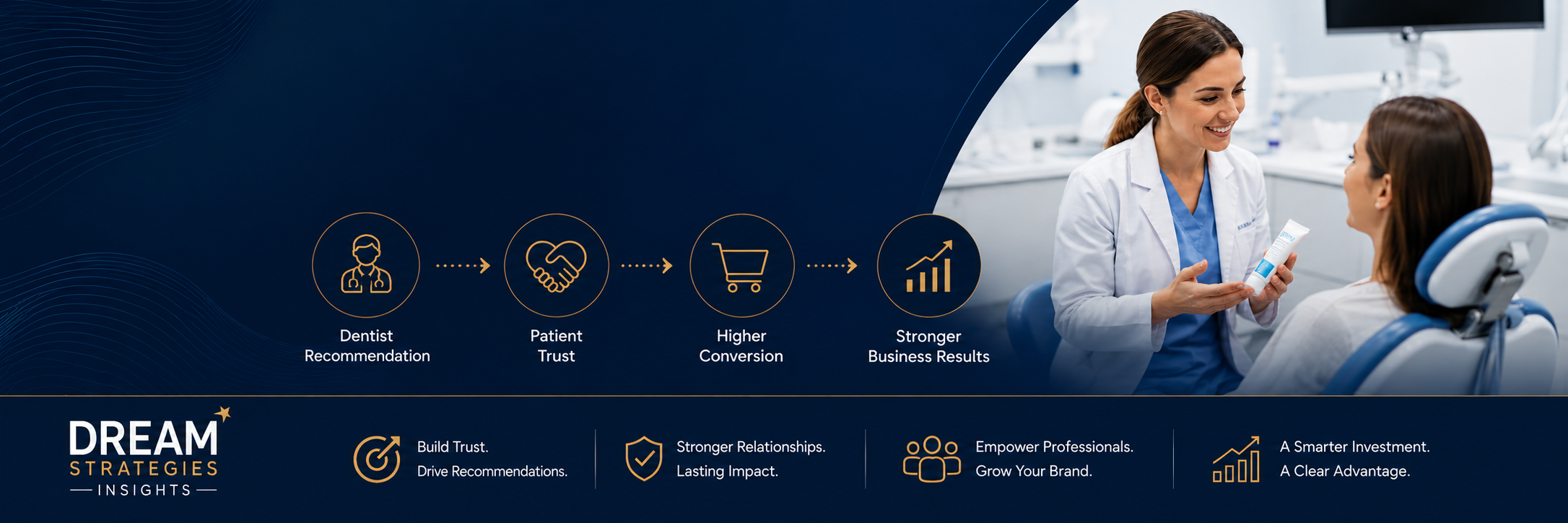
There is a number that should change the way every oral-health brand allocates its marketing budget: 70–80% of patients who receive a specific product recommendation from their dentist or hygienist will act on it. No consumer advertising channel comes close to that conversion rate. Not digital. Not television. Not influencer marketing. Yet most oral-health companies continue to spend the majority of their budget on consumer-facing advertising, while treating professional engagement as a secondary activity, staffed by thinly spread field teams, measured by visit counts rather than outcomes, and managed without the CRM infrastructure that every other commercial channel takes for granted. This is a strategic error, and it is costing brands margin, market share, and long-term defensibility.
The Recommendation Advantage
The dental professional’s recommendation is not merely influential — it is structurally different from any other form of brand communication. When a dentist recommends a product, the patient receives that recommendation in a context of clinical authority, personal trust, and immediate relevance. The recommendation is specific, personal, and anchored to the patient’s own health. No advertisement can replicate these conditions.
The data bears this out. Industry analysis indicates that every 1% increase in dentist recommendation rate correlates with a 2–3% uplift in consumer purchase intent. This is a margin multiplier, not a cost centre. A brand that systematically increases its recommendation rate across a market is building a compounding commercial advantage that competitors cannot easily replicate because they would need to build the same relationships, credibility, and trust from scratch.
Why Most Brands Under-Invest
If the economics are this clear, why do most oral-health companies under-invest in professional advocacy? Three reasons stand out.
First, professional engagement is harder to measure than advertising: Consumer media spend produces familiar metrics reach, frequency, click-through, cost per acquisition. Professional engagement, by contrast, is relationship-based and its commercial impact is indirect. Without proper CRM infrastructure, brands cannot connect a field visit to a recommendation to a purchase. So the spend gets classified as “difficult to quantify” and loses budget share to channels that produce neat dashboards.
Second, professional engagement requires specialist capability. A consumer marketing team can brief an advertising agency and approve creative. Building a professional advocacy system requires a different skill set: clinical credibility, KOL relationship management, evidence-based messaging, field-force design, and CPD programme development. Many oral-health companies lack this capability internally and default to what they know.
Third, the payback period is longer. Advertising produces short-term sales lifts that are visible in weekly data. Professional advocacy compounds over months and years. A KOLDream Strategies Insights who endorse your brand at a conference, a hygienist who recommends your product to every patient, a CPD programme that builds deep familiarity with your clinical story these effects are durable but slow to build. In organisations driven by quarterly targets, the long game often loses to the quick win.
The difference between a valuable advisory board and a wasteful one comes down to structure, substance, and sustained commitment. Leadwith a real question, not a product pitch, and the credibility follows.
What a Modern Professional Advocacy System Looks Like :
The solution is not to abandon consumer marketing it is to build a professional advocacy system that is as strategically rigorous, well resourced, and measurably accountable as your consumer programme. This means four things:
Clinical campaign toolkits: Dentists and hygienists are busy. They do not have time to build their own patient education materials or research your clinical evidence. Provide turnkey resources: pre-built conversation guides, chairside education slides, QR codes linking to evidence summaries, and sample packs that integrate naturally into a 10-minute appointment. Make it effortless for a professional to recommend you.
Tiered partnership programmes: Not all professionals are equal in their influence or willingness to advocate. Build a tiered engagement model: broad awareness for the majority, deeper CPD-accredited education for engaged professionals, and structured advisory board participation for high-value KOLs. Track engagement and recommendation at each tier through CRM.
KOL investment: Identify 15–25 key opinion leaders across periodontology, public health, and hygienist education. Invest in genuine relationships not transactional sponsorship but substantive intellectual engagement through advisory boards, co-authored publications, and conference platforms. These individuals amplify your clinical credibility in ways that no advertisement can.
CRM-enabled field teams: Equip field teams with CRM tools that track every professional interaction, sample deployment, recommendation commitment, and follow-up action. Connect this data to commercial outcomes. When you can show that a specific field investment produced a measurable recommendation uplift that drove a quantifiable sales increase, professional advocacy stops being a “faith-based” investment and becomes a precision commercial channel.
The Compounding Effect: The most important characteristic of professional advocacy is that it compounds. An advertising campaign ends when the budget runs out. A dentist who has been educated on your clinical story, equipped with your materials, and enrolled in your partnership programme will continue recommending your product long after the initial investment. Their recommendation influences not just their patients but their colleagues, their students, and their professional networks.
FAQ
Why are dentist recommendations more effective than advertising?
Dentist recommendations are delivered in a clinical, trusted environment, making them highly credible. Studies show that 70–80% of patients act on a specific product recommendation from a dental professional, which is significantly higher than any consumer advertising channel.
Why should oral-health brands invest more in professional advocacy?
Professional advocacy directly influences patient purchasing decisions and delivers higher conversion rates. Unlike advertising, it builds long-term trust and compounding brand loyalty through dental professionals.
What makes professional engagement harder to implement than consumer marketing?
It is more difficult to measure, requires specialized clinical and relationship-building skills, and delivers long-term rather than immediate results, making it less attractive for short-term marketing KPIs.
How can CRM systems improve professional advocacy in oral health marketing?
CRM systems help track dentist interactions, sample distribution, recommendations, and outcomes, allowing brands to connect field activity directly to sales performance and optimize engagement strategies.